

Interdisciplinary Master's in Information Systems (M.Sc.): Business Informatics studies with a focus on digital transformation at Pforzheim University
Unique interdisciplinary Master's degree in Information Systems (Business Informatics) with a holistic view of people, tasks and IT.
Since 2001, the MIS (Master of Science in Information Systems) at Pforzheim University has been successfully training talented young people for a professional future in business informatics. MIS graduates achieve a high level of employability, which is why the goal of our programme is a 100% placement rate, meaning we strive to ensure that all our graduates find a job immediately. This is our claim and makes us very proud of our graduates.
What you can expect:
- Innovative topics with a focus on digital transformation
- Interdisciplinary connections and a wide range of options in the fields of IT and management
- Nationally and internationally accredited teaching and the opportunity to earn a double degree
- International study experience can be gained, for example, as part of a voluntary semester abroad with a learning agreement – for example, at the IESEG School of Management (Lille or Paris campus) or the Institut Mines-Télécom Business School.
Special features:
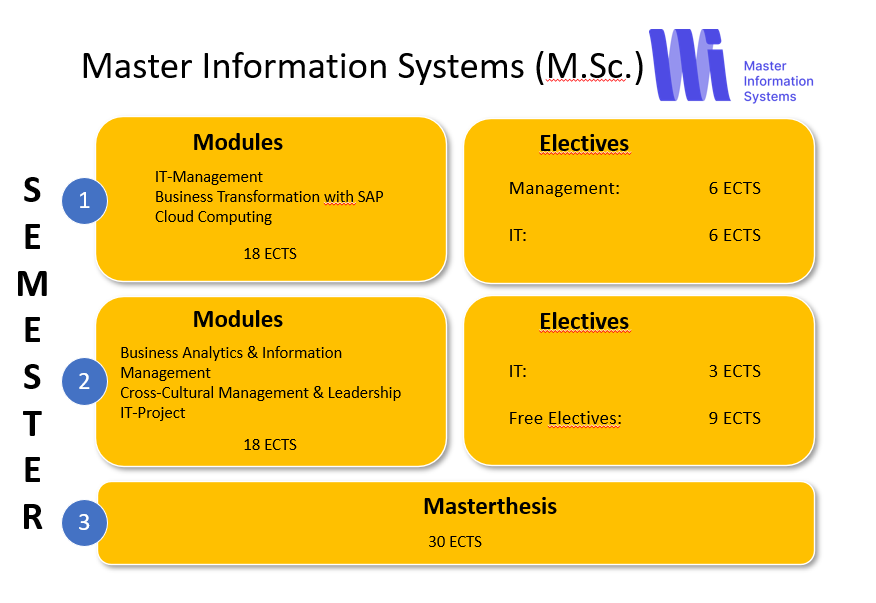
- Wide range of options (individual profile development through elective subjects with a total volume of 24 ECTS from the fields of IT and management)
- The programme opens up and promotes a wide range of opportunities for international experience at international partner universities.
- Double degree programme between HSPF Business School and the University of Ljubljana, School of Economics (LU SEB)
- Doctorate possible afterwards
Typical career fields for our graduates are:
IT consultant, manager, agile coach, business analyst, product owner, project manager, software developer, SAP consultant, solution architect
The M.Sc. Information Systems (MIS) programme focuses on the innovative design of digital transformation and the development of strategies and solutions to master current and future challenges and changes for organisations, structures, systems and culture. The programme focuses on teaching the relevant skills and competencies that companies and organisations need to compete in digital markets in the future.
The M.Sc. Information Systems qualifies students to develop innovative digital solutions for future-oriented business models. Furthermore, the fundamentals of designing and implementing effective and efficient collaborative business processes are taught.
The bilingual, internationally accredited programme analyses the connections between business informatics, applied computer science and business administration.
The MIS programme addresses current topics, trends and the latest technologies from a business informatics perspective. Practical projects and final theses through an excellent network of company contacts, learning and working in small groups, individual support and close, personal contact with lecturers are what set the MIS programme apart.
Our MIS curriculum is continuously updated to meet the current and future requirements for a successful career in business informatics. New topics and areas of focus that are now being offered include:
- Generative AI (AI is the future and is driving digital transformation in companies)
- Business transformation with SAP (business information/application systems)
- Business analytics and process mining (business processes)
- Customer experience, digital service and user-centric solution design (customer interaction and processes at the heart of the strategy)
Please contact us for further information.

Key Facts
Degree
Master of Science
Programme start
Each winter semester
Maximum number of students
20 students
Program
Full-time study with 90 ECTS including thesis
Opportunity to participate in a double degree programme at the University of Ljubljana, School of Economics and Business
Opportunity for a voluntary semester abroad as part of a learning agreement
The person behind the matriculation number is important to us – together with you, we want to help you further develop your potential in the following areas:
• Critical, analytical and creative thinking as well as problem-solving skills
• Communication skills in a global context
• Teamwork and leadership skills
• Knowledge transfer skills
• Ethical awareness
Thanks to the large number of elective subjects, you have the opportunity to set your own individual study focus. We consider application-oriented work in small groups to be an important prerequisite for your successful studies. With 23 professors teaching compulsory and compulsory elective subjects, this results in a student-teacher ratio of 2.6. This allows for a wide range of personal discussions with all lecturers and the Dean of Studies.
Social skills
It is important to us that you enjoy working with your fellow students to develop IT solutions that are tailored to people and businesses.
Professional expertise
You have a first-class degree in economics or engineering.
Ideally, you have specialised in business informatics or applied computer science. However, we are always open to highly motivated career changers.
Language skills
Communicating in English will be part of your everyday working life in the future. We want you to be able to inspire others with your ideas in such situations. That is why we offer various English-language events where you can actively give presentations and write papers. We expect you to have a B2 level of English as a starting point.
The Program Goal
Responsible Leadership in Organizational Contexts
The Learning Objectives (and the assigned competence goals according to the German KMK Qualification)
After completion of the program the students will be able …
1.1 ... to know and to argue relevant leadership principles. (Knowledge Comprehension)
1.2 ... to demonstrate their ability to apply relevant leadership principles. (Application & Transfer)
1.3 ... to demonstrate their critical reflection of relevant leadership principles. (Academic Integrity & Professionalism)
1.4 ... to demonstrate competence to act responsibly. (Knowledge Deepening)
The Program Goal
Creative Problem Solving Skills in a Complex Business Environment
The Learning Objectives (and the assigned competence goals according to the German KMK Qualification)
After completion of the program the students will be able …
2.1 ... to identify, to demarcate, and to classify problems. (Knowledge & Understanding)
2.2 ... to analyze problems independently. (Knowledge & Understanding)
2.3 ... to solve problems creatively and implement appropriate solutions in practice. (Knowledge Application & Generation)
2.4 ... to clarify subject-specific problems. (Communication & Cooperation)
The Program Goal
Research Skills and their Practical Application
The Learning Objectives (and the assigned competence goals according to the German KMK Qualification)
After completion of the program the students will be able …
3.1 ... to know relevant methods and can argue them in a professional context. (Knowledge Application & Generation)
3.2 ... to competently apply relevant research methods. (Knowledge Application & Generation)
3.3 ... to demonstrate the ability to develop new knowledge and procedures, integrate knowledge from different areas to expand knowledge in the field. (Knowledge Application & Generation)
The Program Goal
Design Skills for specific IT Management Solutions or IT Technology Management Architectures within complex Process Structures
The Learning Objectives (and the assigned competence goals according to the German KMK Qualification)
After completion of the program the students will be able …
4.1 ... to demonstrate specialised IT-specific expert knowledge and expertise to design and realize specific solutions or architectures within complex structures. (Knowledge Deepening / Scientific Innovation)
4.2 ... to demonstrate their ability to apply appropriate specialised problem-solving methods to IT-specific tasks. (Application and Transfer)
4.3 ... to demonstrate their ability to identify causal problems for IT-specific tasks in complex process structures and to solve them aligned to professional standards. (Academic Integrity & Professionalism)
Contact
We would be pleased to advise you personally:
mis(at)hs-pforzheim(dot)de
Tel.: +49 7231 28-6095
Room: W2.2.25
If you would like a brief informational meeting about the Master's programme in Information Systems, we invite you to contact us via Teams or Zoom. You can choose whether you would like to speak with one of the available professors or a student.
You can book a direct meeting with Prof. Dr. Peter Weiß right here hier.
We look forward to hearing from you!
MIS-Exkursion zu STACKIT einem Cloud-Anbieter aus Neckarsulm
News
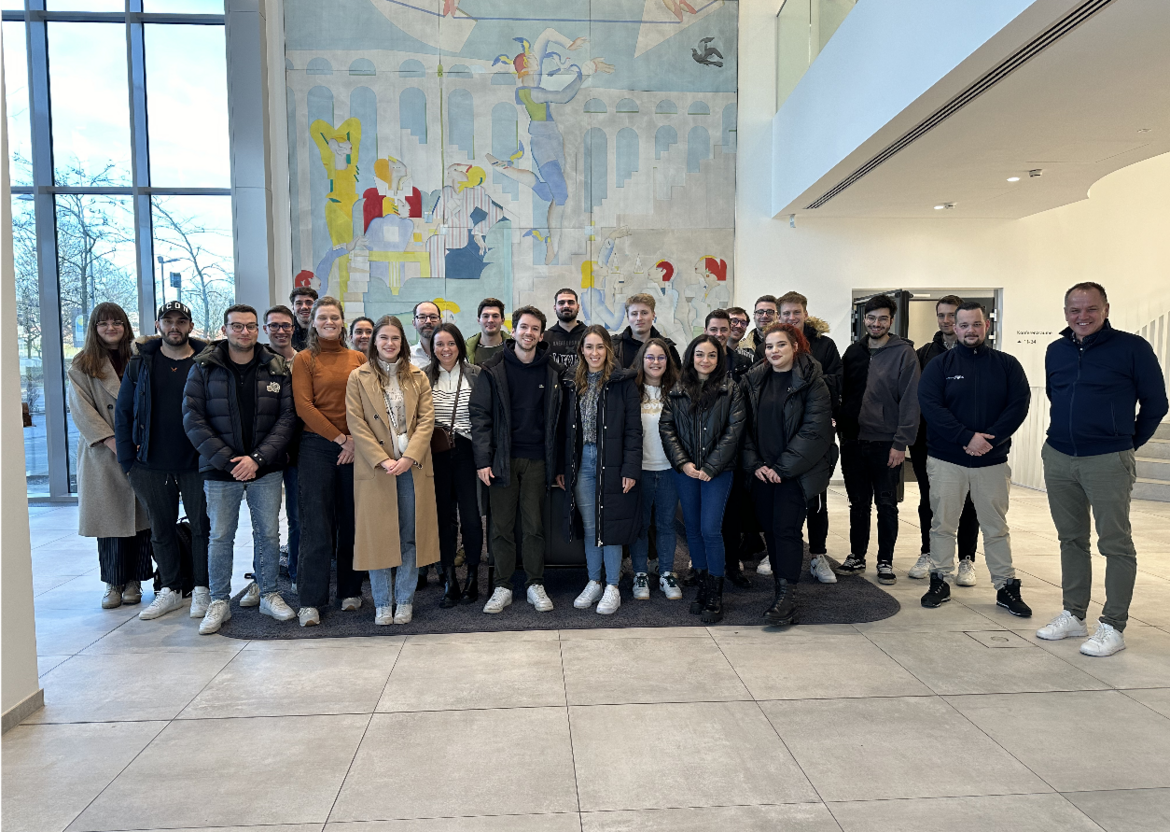
Am Donnerstag, den 07.12.2023 hatten die Studierenden des Masterstudiengangs Information Systems der Hochschule Pforzheim die einmalige Gelegenheit, im Rahmen der Vorlesung "Cloud Computing" von Prof. Dr. Thomas Schuster zusammen mit dem Wissenschaftlichen Mitarbeitenden Lukas Waidelich eine Exkursion zum Cloudanbieter STACKIT nach Neckarsulm zu unternehmen. Ein Reisebus 🚌 holte die Studierenden bereits um 08:00 Uhr an der Hochschule in Pforzheim ab und brachte sie zu dem Hauptsitz des Unternehmens.
Ansprechpartner und Programmgestaltung
Angekommen bei STACKIT, wurden die Studierenden von Kai-Uwe Besir, Senior Professional bei Schwarz IT GmbH & Co. KG, herzlich empfangen. Er fungierte als Ansprechpartner und führte die Gruppe durch ein spannendes Rahmenprogramm. Am Vormittag stand zunächst die persönliche Vorstellung von Herrn Besir auf dem Programm. Dabei erhielten die Studierenden nicht nur Einblicke in seinen beruflichen Hintergrund, sondern auch in seine Funktion im Unternehmen und eine umfassende Unternehmensvorstellung. Dies legte den Grundstein für einen regen Austausch und eine fruchtbare Diskussion im Anschluss.
Rechenzentrum-Besichtigung: Die Technik hinter der Cloud
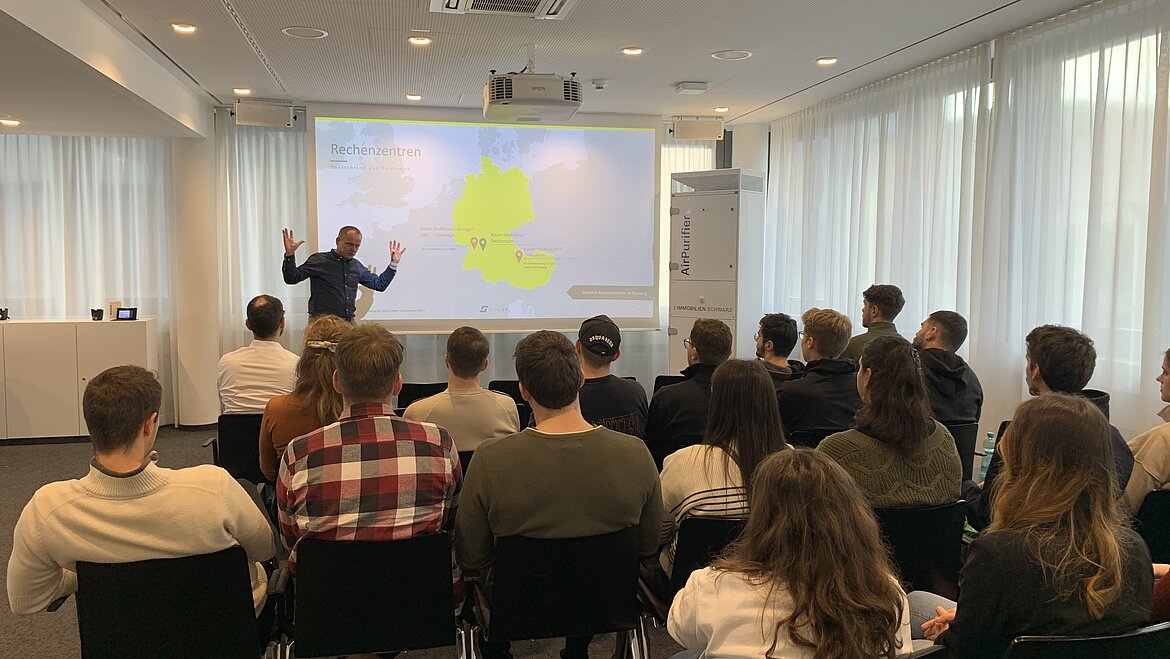
Der Höhepunkt der Exkursion war zweifelsohne die Vorstellung und Begehung des Rechenzentrums in Neckarsulm. Hier wurden verschiedene Bereiche präsentiert, die die Funktionsweise eines modernen Rechenzentrums verdeutlichen:
- Server-Racks und -Schränke 🖥️: Hier werden die Server und andere Hardwarekomponenten untergebracht.
- Server 💽: Leistungsstarke Computer, die für die Verarbeitung von Daten und die Bereitstellung von Diensten verantwortlich sind.
- Netzwerkinfrastruktur 🌐: Router, Switches, Firewalls und andere Netzwerkkomponenten, die die Kommunikation zwischen den verschiedenen Servern und externen Netzwerken ermöglichen.
- Speichersysteme 💾: Zur sicheren und effizienten Speicherung von Daten werden spezialisierte Speichersysteme wie SANs (Storage Area Networks) oder NAS (Network Attached Storage) eingesetzt.
- Klimatisierung und Kühlung ❄️: Rechenzentren erzeugen viel Wärme, daher sind Klimaanlagen und Kühlungssysteme notwendig.
- USV (unterbrechungsfreie Stromversorgung) 🔋: Sorgt dafür, dass das Rechenzentrum auch bei Stromausfällen betriebsbereit bleibt.
- Generator 🔄: Im Falle eines längeren Stromausfalls stellt ein Generator die notwendige Energie bereit.
- Sicherheitseinrichtungen 🔐: Physische Sicherheitsmaßnahmen wie Überwachungskameras, Zugangskontrollen und andere Sicherheitsvorkehrungen.
- Brandbekämpfungssysteme 🚨: Installierte Brandmeldesysteme und automatische Feuerlöschanlagen für die Sicherheit.
- Monitoring und Management-Tools 📊: Überwachen und Verwalten des Zustands der Hardware, Netzwerke und anderer Systeme im Rechenzentrum.
- Backup- und Wiederherstellungssysteme 🔄💾: Verhindern Datenverlust durch regelmäßige Sicherungen.
- Verkabelung und Verbindungselemente 🔗: Strukturierte Verkabelungssysteme für die effiziente Verbindung aller Geräte im Rechenzentrum.
Mittagspause im Mitarbeitenden-Restaurant
Nach dieser eindrucksvollen Vormittagsrunde legte die Exkursionsgruppe eine wohlverdiente Mittagspause im Mitarbeitenden-Restaurant der Schwarz-Gruppe ein. Hier bot sich nicht nur die Gelegenheit zur Stärkung, sondern auch zu informellen Gesprächen und einem intensiven Austausch über die gewonnenen Eindrücke.
Nachmittags: Die STACKIT-Cloud im Fokus
Am Nachmittag hatte Max Baumgartl, Cloud Sales Consultant bei STACKIT, das Wort. In einem spannenden Vortrag präsentierte er die Funktionalitäten der STACKIT-Cloud-Lösung. Besonders hervorgehoben wurden die Unterschiede zwischen On-Premises- und SaaS-Lösungen sowie die strategischen Ziele von STACKIT. Die Studierenden waren erneut aktiv in die Diskussion eingebunden, was zu einem regen Austausch von Ideen und Perspektiven führte.
Abschluss und Fazit: Ein erfolgreicher Tag voller Erkenntnisse
Der Tag fand einen gelungenen Abschluss mit einem Gruppenfoto, das Kai-Uwe Besir, Max Baumgartl und die Exkursionsgruppe der Hochschule Pforzheim zeigt. Die Exkursion bot nicht nur einen tiefen Einblick in die Technologien des Cloud Computings, sondern ermöglichte auch wertvolle Kontakte zu erfahrenen Fachleuten in der Branche. Der Besuch bei STACKIT, der digitalen Marke der Schwarz IT und Teil der Schwarz Gruppe, zu der Lidl und Kaufland gehören, war zweifellos lohnend und lehrreich für die Studierenden des Masterstudiengangs Information Systems.