

Interdisciplinary Master's in Information Systems (M.Sc.): Business Informatics studies with a focus on digital transformation at Pforzheim University
Unique interdisciplinary Master's degree in Information Systems (Business Informatics) with a holistic view of people, tasks and IT.
Since 2001, the MIS (Master of Science in Information Systems) at Pforzheim University has been successfully training talented young people for a professional future in business informatics. MIS graduates achieve a high level of employability, which is why the goal of our programme is a 100% placement rate, meaning we strive to ensure that all our graduates find a job immediately. This is our claim and makes us very proud of our graduates.
What you can expect:
- Innovative topics with a focus on digital transformation
- Interdisciplinary connections and a wide range of options in the fields of IT and management
- Nationally and internationally accredited teaching and the opportunity to earn a double degree
- International study experience can be gained, for example, as part of a voluntary semester abroad with a learning agreement – for example, at the IESEG School of Management (Lille or Paris campus) or the Institut Mines-Télécom Business School.
Special features:
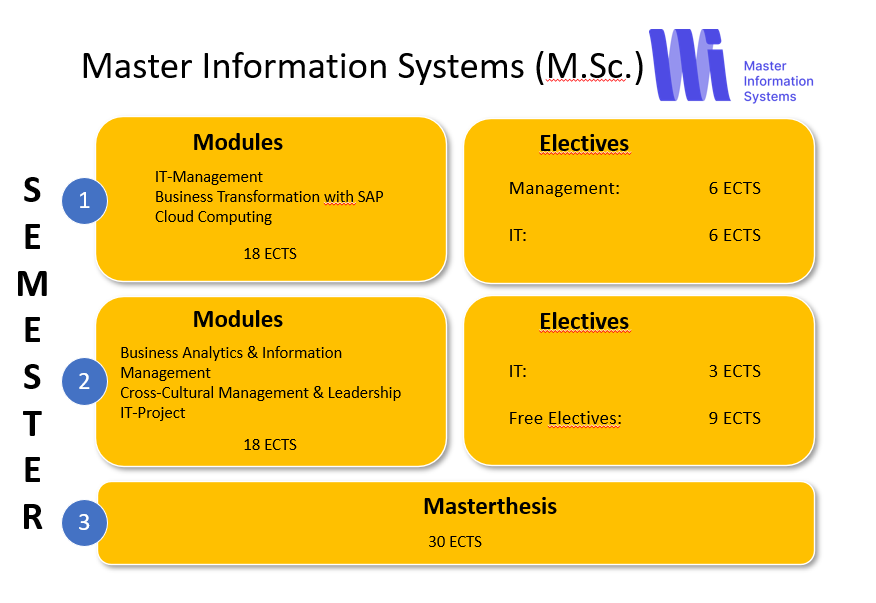
- Wide range of options (individual profile development through elective subjects with a total volume of 24 ECTS from the fields of IT and management)
- The programme opens up and promotes a wide range of opportunities for international experience at international partner universities.
- Double degree programme between HSPF Business School and the University of Ljubljana, School of Economics (LU SEB)
- Doctorate possible afterwards
Typical career fields for our graduates are:
IT consultant, manager, agile coach, business analyst, product owner, project manager, software developer, SAP consultant, solution architect
The M.Sc. Information Systems (MIS) programme focuses on the innovative design of digital transformation and the development of strategies and solutions to master current and future challenges and changes for organisations, structures, systems and culture. The programme focuses on teaching the relevant skills and competencies that companies and organisations need to compete in digital markets in the future.
The M.Sc. Information Systems qualifies students to develop innovative digital solutions for future-oriented business models. Furthermore, the fundamentals of designing and implementing effective and efficient collaborative business processes are taught.
The bilingual, internationally accredited programme analyses the connections between business informatics, applied computer science and business administration.
The MIS programme addresses current topics, trends and the latest technologies from a business informatics perspective. Practical projects and final theses through an excellent network of company contacts, learning and working in small groups, individual support and close, personal contact with lecturers are what set the MIS programme apart.
Our MIS curriculum is continuously updated to meet the current and future requirements for a successful career in business informatics. New topics and areas of focus that are now being offered include:
- Generative AI (AI is the future and is driving digital transformation in companies)
- Business transformation with SAP (business information/application systems)
- Business analytics and process mining (business processes)
- Customer experience, digital service and user-centric solution design (customer interaction and processes at the heart of the strategy)
Please contact us for further information.

Key Facts
Degree
Master of Science
Programme start
Each winter semester
Maximum number of students
20 students
Program
Full-time study with 90 ECTS including thesis
Opportunity to participate in a double degree programme at the University of Ljubljana, School of Economics and Business
Opportunity for a voluntary semester abroad as part of a learning agreement
The person behind the matriculation number is important to us – together with you, we want to help you further develop your potential in the following areas:
• Critical, analytical and creative thinking as well as problem-solving skills
• Communication skills in a global context
• Teamwork and leadership skills
• Knowledge transfer skills
• Ethical awareness
Thanks to the large number of elective subjects, you have the opportunity to set your own individual study focus. We consider application-oriented work in small groups to be an important prerequisite for your successful studies. With 23 professors teaching compulsory and compulsory elective subjects, this results in a student-teacher ratio of 2.6. This allows for a wide range of personal discussions with all lecturers and the Dean of Studies.
Social skills
It is important to us that you enjoy working with your fellow students to develop IT solutions that are tailored to people and businesses.
Professional expertise
You have a first-class degree in economics or engineering.
Ideally, you have specialised in business informatics or applied computer science. However, we are always open to highly motivated career changers.
Language skills
Communicating in English will be part of your everyday working life in the future. We want you to be able to inspire others with your ideas in such situations. That is why we offer various English-language events where you can actively give presentations and write papers. We expect you to have a B2 level of English as a starting point.
The Program Goal
Responsible Leadership in Organizational Contexts
The Learning Objectives (and the assigned competence goals according to the German KMK Qualification)
After completion of the program the students will be able …
1.1 ... to know and to argue relevant leadership principles. (Knowledge Comprehension)
1.2 ... to demonstrate their ability to apply relevant leadership principles. (Application & Transfer)
1.3 ... to demonstrate their critical reflection of relevant leadership principles. (Academic Integrity & Professionalism)
1.4 ... to demonstrate competence to act responsibly. (Knowledge Deepening)
The Program Goal
Creative Problem Solving Skills in a Complex Business Environment
The Learning Objectives (and the assigned competence goals according to the German KMK Qualification)
After completion of the program the students will be able …
2.1 ... to identify, to demarcate, and to classify problems. (Knowledge & Understanding)
2.2 ... to analyze problems independently. (Knowledge & Understanding)
2.3 ... to solve problems creatively and implement appropriate solutions in practice. (Knowledge Application & Generation)
2.4 ... to clarify subject-specific problems. (Communication & Cooperation)
The Program Goal
Research Skills and their Practical Application
The Learning Objectives (and the assigned competence goals according to the German KMK Qualification)
After completion of the program the students will be able …
3.1 ... to know relevant methods and can argue them in a professional context. (Knowledge Application & Generation)
3.2 ... to competently apply relevant research methods. (Knowledge Application & Generation)
3.3 ... to demonstrate the ability to develop new knowledge and procedures, integrate knowledge from different areas to expand knowledge in the field. (Knowledge Application & Generation)
The Program Goal
Design Skills for specific IT Management Solutions or IT Technology Management Architectures within complex Process Structures
The Learning Objectives (and the assigned competence goals according to the German KMK Qualification)
After completion of the program the students will be able …
4.1 ... to demonstrate specialised IT-specific expert knowledge and expertise to design and realize specific solutions or architectures within complex structures. (Knowledge Deepening / Scientific Innovation)
4.2 ... to demonstrate their ability to apply appropriate specialised problem-solving methods to IT-specific tasks. (Application and Transfer)
4.3 ... to demonstrate their ability to identify causal problems for IT-specific tasks in complex process structures and to solve them aligned to professional standards. (Academic Integrity & Professionalism)
Contact
We would be pleased to advise you personally:
mis(at)hs-pforzheim(dot)de
Tel.: +49 7231 28-6095
Room: W2.2.25
If you would like a brief informational meeting about the Master's programme in Information Systems, we invite you to contact us via Teams or Zoom. You can choose whether you would like to speak with one of the available professors or a student.
You can book a direct meeting with Prof. Dr. Peter Weiß right here hier.
We look forward to hearing from you!
Visit of the partner university SCIT at Pforzheim University - deepening a long-standing cooperation
News

Pforzheim University of Applied Sciences and its partner university SCIT have enjoyed a close and very personal working relationship for many years. As part of this long-standing cooperation, Prof. Dr. S. Vijaykumar Bharathi and Prof. Dr. Mandaar Pande visited Pforzheim University in December to deepen existing relationships, discuss current developments in teaching and research and explore new joint perspectives. The visit was organized in close coordination between the members of Pforzheim University involved, in particular Prof. Dr. Frank Morelli, Prof. Dr. Rebecca Bulander and Prof. Dr. Manuel Fritz, who are actively involved in shaping the collaboration with SCIT in the field of business informatics and process mining.
After arriving at the train station, the guests were welcomed by Prof. Dr. Rebecca Bulander and enjoyed a coffee together on campus. The subsequent discussion with the Dean of the Faculty of Engineering, Prof. Dr Ingolf Müller, focused on current developments in the degree programmes, internationalization and the role of digital technologies. Over lunch in the Seehaus, there was an opportunity to talk about joint teaching formats, student exchanges and possible duplication of teaching in a relaxed atmosphere. Prof. Dr. Rebecca Bulander had also organized a welcome gift with typical specialties from Baden-Württemberg, which once again underlined the personal appreciation for the guests.
A visit to the Rectorate followed in the afternoon, during which Prof. Dr. Ulrich Jautz explained the strategic orientation of Pforzheim University and emphasized the importance of international cooperation for research, teaching and profile building. Another item on the program was a visit to the Faculty of Design, where the potential of interdisciplinary cooperation between design, business and IT was discussed. The subsequent excursion to the Gasometer, a joint visit to the Pforzheim Christmas market and a round of curling created an informal setting that deepened the personal exchange and further strengthened the already friendly relationship between the institutions.
In terms of content, the discussions focused in particular on the interfaces between process mining and artificial intelligence. Specific starting points for joint projects in teaching and research were discussed, for example in the form of international case studies, joint Master's projects or cooperative events. Prof. Dr. Manuel Fritz made important technical contributions on these topics, so it quickly became clear that both sides have a strong interest in expanding cooperation in these strategic fields.
Overall, SCIT's visit not only confirmed the long-standing collaboration, but also visibly deepened it. There is a clear desire on both sides to further intensify academic exchange, provide students with additional mobility and project experience and advance joint initiatives in the fields of digital technologies, process mining and data-driven decision support. Pforzheim University looks back on the visit with great appreciation and looks forward to translating the ideas initiated on this day into concrete cooperation projects.